Key Takeaways
- Break large writing assignments into short, visible steps.
- Use planning routines to help students organize ideas before drafting.
- Teach one writing skill at a time through modeling and guided practice.
- Give students reasons to write across subjects, purposes, and audiences.
- Help writers revise ideas and clarity before focusing on mechanics.
Fourth grade is an important time for building writing habits that students can carry into every subject. The most effective support is usually not a bigger assignment or a longer checklist. It is a dependable routine that helps children turn an idea into a clear draft, then improve it a little at a time. Teachers and families can find age-appropriate prompts, planning activities, and skill practice in these fourth-grade writing resources from experts at https://studentreasures.com/teachers-lounge/lesson-plans/fourth-grade/.
Students do not need to master every writing skill in one lesson. They need a clear goal, an example of what that goal looks like, time to practice, and feedback on what to try next. With those supports in place, a blank page becomes much less intimidating.
Why Writing Can Feel Hard In Fourth Grade
Many fourth graders have strong ideas but struggle to decide where to begin. A student may know a great deal about volcanoes, a favorite family trip, or a book they just finished, yet still write only a few sentences. Common barriers include repeating the same words, skipping necessary details, writing an unclear opening, or shifting between ideas without logical order.
Clear routines reduce the number of decisions students must make at once. Instead of hearing, “Write a report,” they can hear, “Today we will choose one main idea and list three details.” The What Works Clearinghouse recommends regular time for writing, instruction in the writing process for different purposes, and an engaged community of writers in elementary classrooms.
Start With A Simple Writing Goal
Choose one manageable target for each lesson. It might be adding sensory details, writing a focused topic sentence, using stronger verbs, or organizing events in sequence. State the goal in student-friendly language, such as “I can help my reader picture where my story happens.”
- Show a brief example that includes the target skill.
- Point out exactly where the skill appears.
- Try the skill together in a shared sentence or paragraph.
- Give students a short chance to use it in their own work.
Use A Four-Part Planning Routine
A simple routine can work for stories, reports, opinion pieces, and reading responses:
- Think: List possible ideas without judging them too quickly.
- Choose: Select the idea that best fits the assignment.
- Order: Decide what comes first, next, and last.
- Explain: Add facts, examples, actions, reasons, or sensory details.
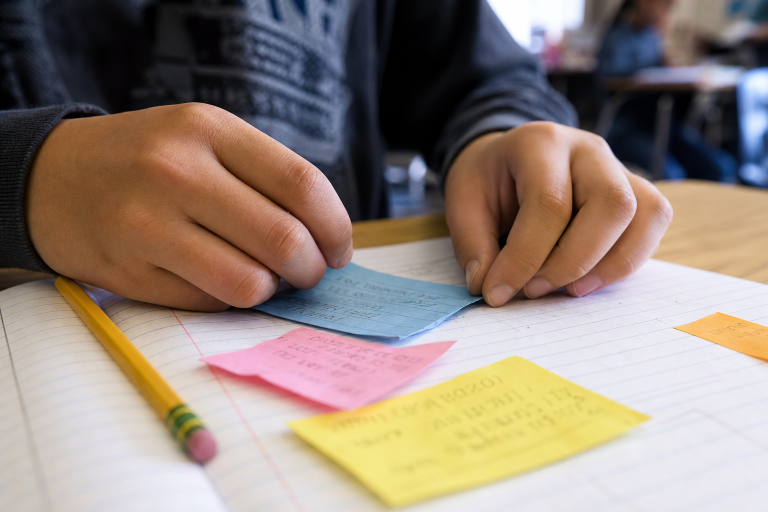
A planning page can include four labeled boxes: main idea, beginning, supporting details, and ending. For an opinion paragraph, students can replace “beginning” with “claim,” then use the detail boxes for reasons and examples.
Model The Writing Process Out Loud
Students benefit from seeing an adult writer make real decisions. Start with a broad topic, such as recess, then explain why “the day our class played a new game” is more focused. Think aloud as you choose details, rearrange a sentence, cross something out, or decide that a word is too general.
When teachers write alongside students, they show that revision is a normal part of the process, not proof that someone did it wrong. The Institute of Education Sciences describes how teacher modeling can make the processes of planning, drafting, reconsidering, and correcting visible to young writers by thinking aloud about writing choices.
Build Strong Paragraphs One Layer At A Time
Teach paragraph development as a sequence rather than a mystery. Students can begin with a topic sentence, add two or three details, include an example, and finish with a sentence that completes the thought or leads into the next one.
From Basic To Developed
Basic: “The school garden is good. We grow plants there. I like it.”
Developed: “The school garden gives our class a place to learn science outdoors. We measure the plants each week and notice how sunlight and water affect their growth. I especially like checking the tomato plants because we can see changes quickly.”
Give Students More Than One Type Of Writing
- Narrative writing: Stories with characters, settings, events, and endings.
- Informative writing: Explanations that use facts, definitions, steps, and examples.
- Opinion writing: A claim supported by reasons and relevant evidence.
- Reflective writing: Short responses about learning, choices, and growth.
Varied writing tasks teach students to adjust their structure, tone, and details for a purpose. A story about a storm needs a different approach from a scientific explanation of how storms form.
Make Word Choice More Precise
Before drafting, create a small word bank connected to the topic. Students writing about a playground might collect verbs such as raced, balanced, swung, and climbed. They can replace vague words such as nice, fun, or thing with language that tells the reader more. Comparing two sentences, one with general verbs and one with precise verbs, makes this skill concrete.
Teach Revision Before Copyediting
Revision improves meaning, organization, details, and clarity. Editing checks spelling, capitalization, punctuation, and grammar. Both matter, but students should first make sure the piece says what they intend it to say.
- Does my writing stay on topic?
- Can a reader follow the order of my ideas?
- Have I added enough useful details?
- Can I replace repeated or weak words?
- Is there a sentence I can remove, move, or improve?
Use Peer Feedback That Students Can Handle
Keep peer review focused and brief. Pair students with one lesson goal and provide sentence starters: “One part that is clear is…” and “One detail that could help the reader is…” Writers should decide which suggestions fit their work. This keeps feedback respectful while preserving student ownership.
Connect Writing To Other Subjects
Writing becomes more meaningful when it helps students learn. Ask them to explain a science process in numbered steps, write a diary entry from a historical viewpoint, describe how they solved a math problem, or respond to a text with evidence and personal thinking. These tasks show that writing is a tool for organizing knowledge, not only a language arts assignment.
Support Students With Different Needs
Offer planning templates, word banks, sentence frames, and model paragraphs for students who need added structure. Oral rehearsal or speech-to-text may help some writers get ideas down before handwriting becomes a barrier. Short teacher conferences can identify one next step, while advanced writers can add a second viewpoint, more specific evidence, or a more complex structure.
A Five-Day Classroom Writing Cycle
- Day One: Introduce the purpose and gather ideas.
- Day Two: Plan and draft the first section.
- Day Three: Finish the draft and check organization.
- Day Four: Use peer feedback and revise.
- Day Five: Edit, publish, share, or reflect.
Helpful Questions From Teachers And Families
How long should a writing task take?
Match the time to the goal. A single paragraph may take one or two sessions, while a polished multi-paragraph piece can develop over a week.
What if a student cannot think of an idea?
Offer a choice of prompts, invite oral storytelling, or ask the student to list familiar people, places, problems, and memories.
Should adults correct every first draft?
No. Start with the lesson goal and one or two high-value revisions. Save extensive proofreading for later.
Useful Research And Teacher Resources
Teachers looking for a research-based foundation can use the What Works Clearinghouse guide on teaching elementary students to be effective writers, which includes recommendations for writing time, writing-process instruction, foundational skills, and supportive writing communities.
Conclusion
Fourth-grade writers grow when writing is taught as a series of manageable choices. Clear goals, useful models, planning time, respectful feedback, and focused revision help students move from getting started to communicating with confidence. Small steps, practiced consistently, can lead to stronger pages.