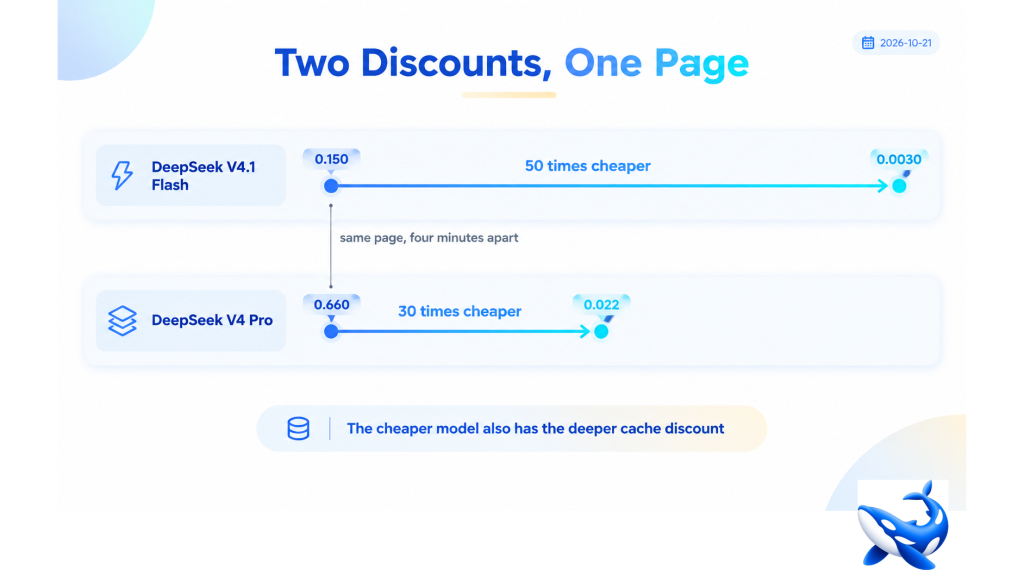
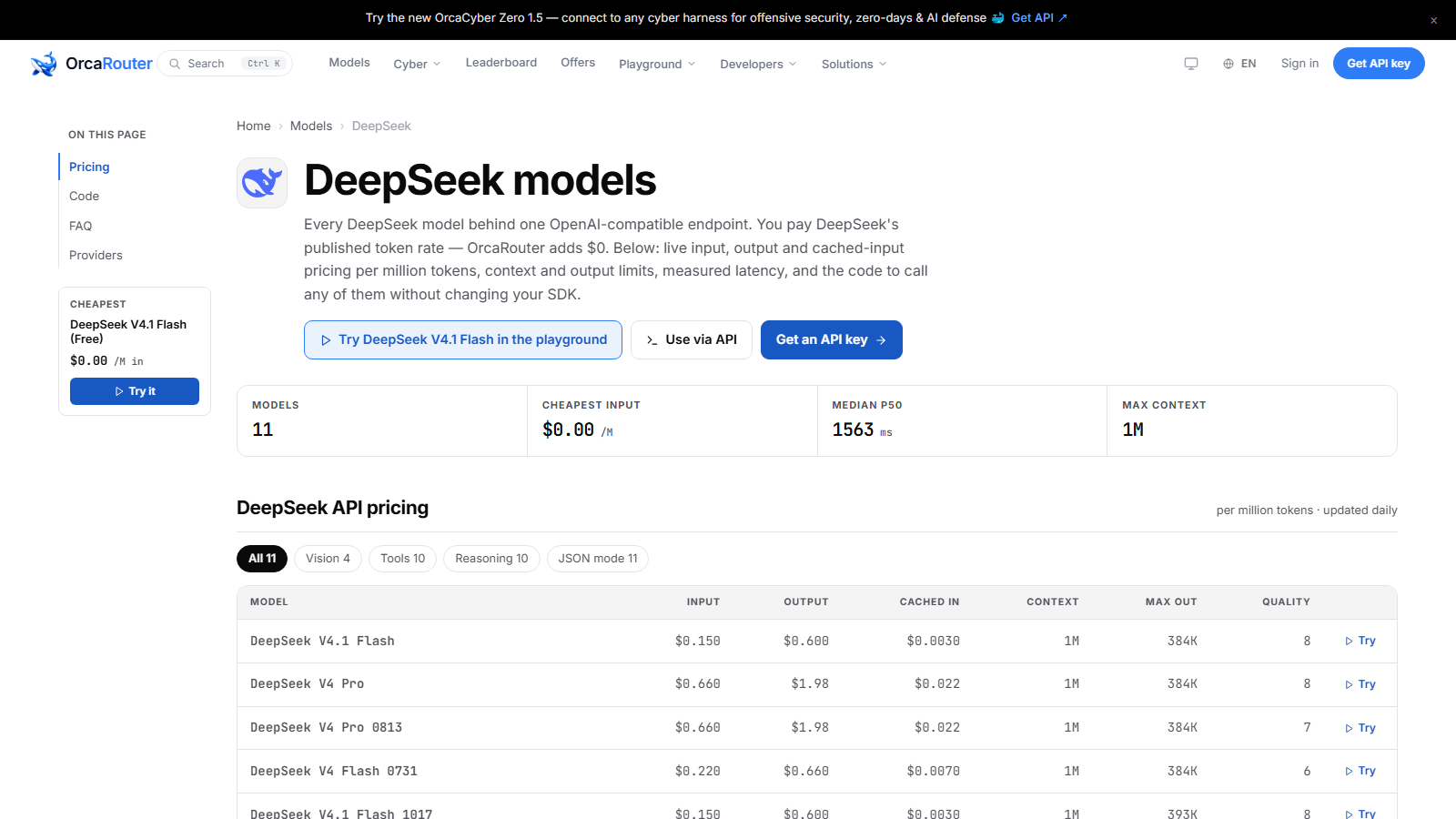
The OrcaRouter Deepseek API page prints three prices per row: input, output and cached input. Read the cached column as a discount and two rows stand out, because they are the two the catalogue is built around. V4.1 Flash drops from $0.150 to $0.0030 per million tokens — a factor of 50 [VENDOR: the provider’s published rates, passed through with no markup]. V4 Pro drops from $0.660 to $0.022, a factor of 30.
Two discounts, one page, one scrolling distance apart. And they run the wrong way round from the intuition most teams carry, which is that the expensive tier gets the better cache economics.
What a cache discount actually is
Before comparing the two, it is worth being precise about what the cached rate buys, because the phrase “cache discount” covers two different products in the market.
The rate applies to input tokens the provider recognises as a repeat of a prefix it has already processed. You send the same long system prompt, the same retrieved document, the same tool schema, and the matching portion bills at the cached rate rather than the full input rate. Nothing about the output changes. Nothing about quality changes. The discount is a property of repetition.
So the cached rate is not a cheaper model. It is the same model, priced lower for the part of the request it can skip. That framing matters because it means the ratio between input and cached price is the one number that tells you how much a provider values that skip — and it is a policy choice, not a cost of goods.
Thirty times and fifty times are both aggressive by the standards of the market. The OpenAI catalogue’s most common ratio is ten; Anthropic’s is ten across twelve rows and tighter still on two; Z.ai ranges from fifteen to twenty-six across its ten rows [OURS]. DeepSeek’s two headline models sit above all of those, and the cheaper of the two sits furthest above.
Why the cheaper model has the deeper discount
There is a mechanical explanation that does not require any claim about intent.
A cache hit saves the provider the cost of re-processing a prefix, and that cost is roughly proportional to the compute the model spends on it. Flash is a smaller, faster model; Pro is a larger one. Whatever the absolute cost of a cached prefix is on each, the provider has chosen to price the saving as a percentage of that model’s own input rate rather than as an absolute figure. If the two models’ cache economics were identical in percentage terms, both rows would show the same ratio. They do not, so either the underlying saving differs, or the pricing policy does.
The direction is informative either way. A 50× discount on the cheap row means a workload that is mostly repeated prefix can drive its input cost close to zero — $0.003 per million tokens is three tenths of a cent for a million tokens. A 30× discount on the expensive row means the same workload’s input cost lands at $0.022 per million, still low, but seven times higher in absolute terms.
That gap is where caching decisions stop being about percentages and start being about product. $0.150 versus $0.660 is a 4.4× gap on full-rate input. On cached input the gap is $0.0030 versus $0.022, or 7.3×. Caching does not shrink the price difference between the two models; it widens it.
|
V4.1 Flash |
V4 Pro |
Ratio |
|
|---|---|---|---|
|
Input per 1M |
$0.150 |
$0.660 |
4.4× |
|
Cached input per 1M |
$0.0030 |
$0.022 |
7.3× |
|
Output per 1M |
$0.600 |
$1.98 |
3.3× |
|
Input ÷ cached |
50× |
30× |
— |
|
Output ÷ input |
4.0× |
3.0× |
— |
The arithmetic on a realistic workload
Take a workload that sends a 40,000-token prefix on every call and generates 800 tokens per call — a plausible shape for a retrieval-augmented system with a fixed instruction block, a document and a short answer.
Ten thousand calls means 400 million input tokens and 8 million output tokens. With a 100 percent cache hit rate on the prefix:
• V4.1 Flash: 400M × $0.0030 ÷ 1,000,000 = $1.20 in, 8M × $0.600 ÷ 1,000,000 = $4.80 out. Total $6.00.
• V4 Pro: 400M × $0.022 ÷ 1,000,000 = $8.80 in, 8M × $1.98 ÷ 1,000,000 = $15.84 out. Total $24.64.
Now drop the cache entirely:
• V4.1 Flash: 400M × $0.150 ÷ 1,000,000 = $60.00 in, $4.80 out. Total $64.80.
• V4 Pro: 400M × $0.660 ÷ 1,000,000 = $264.00 in, $15.84 out. Total $279.84.
Three things fall out of those four numbers, and none of them is visible from the discount ratios alone [OURS arithmetic on VENDOR rates].
First, caching is the whole cost story on this shape. Without it, input is 93 percent of the Flash bill and 94 percent of the Pro bill. With it, input drops to 20 percent and 36 percent respectively and output becomes the larger term on Flash.
Second, a 50× discount does not produce a 50× saving. On the cached workload above, the Flash bill is $6.00; the naive expectation might be that caching turns $60 into $1.20, which it does on the input line and not on the total. The output line is untouched at $4.80, so the achievable saving on the whole bill is 91 percent, not 98.
Third, the 50×-versus-30× gap is worth $7.60 on this workload — $8.80 against $1.20 on the input line. That is the real price of choosing the tier with the shallower discount when your traffic is prefix-heavy. On an 800-token-output workload it is a material fraction of the bill; on a workload with 4,000-token outputs it would shrink toward rounding.
The shape of the workload, not the size of the ratio, decides which of these numbers matter.
The rows that contradict the pattern
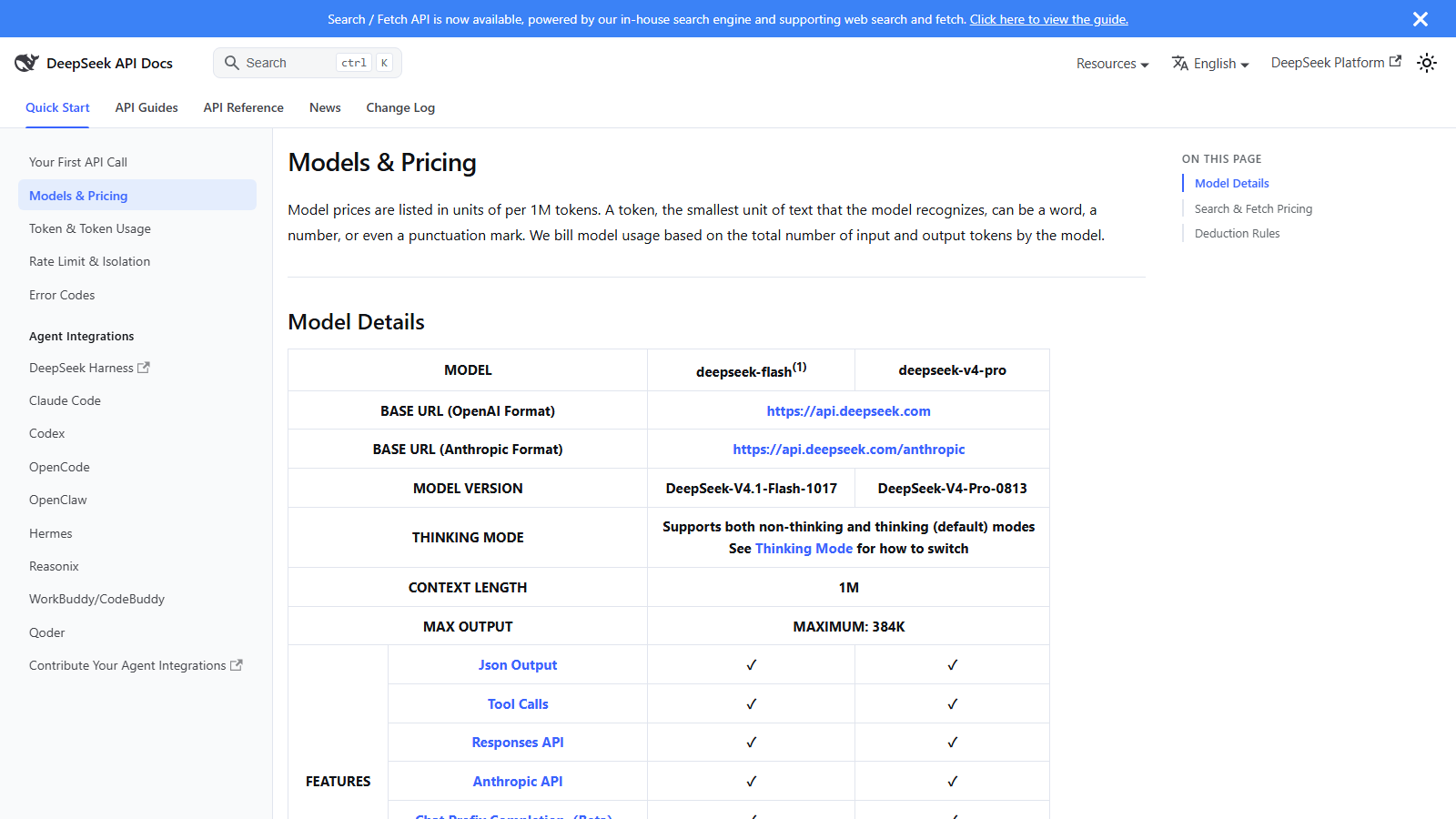
Two rows on the same page break the neat two-discount story, and both are worth knowing about because they are the ones a careful reader will trip over.
`DeepSeek V4 Flash 0731` prices at $0.220 in, $0.660 out and $0.0070 cached — a ratio of 31.4×. `deepseek/deepseek-reasoner` prices at $0.242, $0.726 and $0.0077 — also 31.4×. Neither is 50 and neither is 30; both are close to the Pro ratio without being exactly it.
So the page carries three distinct cache ratios, not two: 50.0× on the two V4.1 Flash rows, 31.4× on two older or derived rows, and 30.0× on the two V4 Pro rows [OURS arithmetic on the printed rates]. A reader who generalises from the two headline numbers to the whole catalogue will be wrong by a few percent on four of the nine paid rows.
There is also one row with no cached price at all: `DeepSeek V4 Flash (Free)` bills per request, so a per-token cache rate has nothing to attach to. And the two free rows carry no output rate, which means they cannot be modelled on this arithmetic in either direction.
The one qualifier that applies to every row
Everything above assumes the printed rates apply. On this page, for nine of the eleven rows, they apply for seventeen hours out of twenty-four.
The underlying model data carries a 2× multiplier on two UTC windows, 01:00–04:00 and 06:00–10:00 [OURS: this is DeepSeek-specific; the other eight provider catalogues carry no time-based pricing at all]. Inside those seven hours, $0.150 becomes $0.300, $0.600 becomes $1.20, and $0.0030 becomes $0.0060 — the same ratios, at double the price.
The ratio survives the multiplier, which is the good news: a cache discount of 50× is 50× at any hour. The absolute saving does not survive it. A workload scheduled entirely inside a peak window pays twice as much per cached token as the table suggests, and the decision between Flash and Pro does not change, but the size of the number you are optimising does. If you are choosing a tier on a $6.00-versus-$24.64 monthly difference, check which hours you run in before you commit to the comparison.
How to use a cache ratio without being misled
Four checks, in the order they save the most time.
Turn the ratio into a per-token figure before you compare it to anything else. 50× sounds larger than 30× by two thirds; in dollars it is $0.0030 against $0.022, which is a difference of $0.019 per million tokens. Whether that matters depends entirely on how many million tokens you send.
Multiply by your prefix share. A cache discount only applies to the part of the request that repeats. If your prompts are 90 percent unique content, no ratio helps; if they are 90 percent fixed prefix, the ratio is close to the whole input story.
Remember the output line is outside the deal. On the Flash row, output is four times input at full rate and, once the prefix is cached, output becomes the dominant term of the bill. The deepest cache discount on the page cannot touch it.
Check whether the printed rate is the whole rate. Seven hours a day, on this provider, it is not. The ratios hold; the absolute numbers double.
A cache discount is the most quoted and least modelled number on any price page. Fifty and thirty are both real, both large, and both smaller than they look once the output line enters the arithmetic.
You may also like: Choosing the Right Two Way Radio for Everyday Communication Needs
Sourcing note: every rate quoted here — input, output and cached-input, for all eleven DeepSeek rows — is read from the OrcaRouter DeepSeek provider page on 2026-10-21, where those rates are the provider’s published prices passed through with $0 markup [VENDOR]. The four cache ratios and the row-by-row arithmetic are ours [OURS], as is the peak-window multiplier of 2× across 01:00–04:00 and 06:00–10:00 UTC, which is carried in the page’s own model data and is specific to this provider. The monthly and per-workload figures are our own arithmetic on a stated shape — 40,000-token prefix, 800-token output, ten thousand calls — and are not a quote from any vendor. The 0-to-10 quality scores, where mentioned, are our own composite. No third-party evaluation figures are used. Rates and multipliers change; all values checked 2026-10-21.