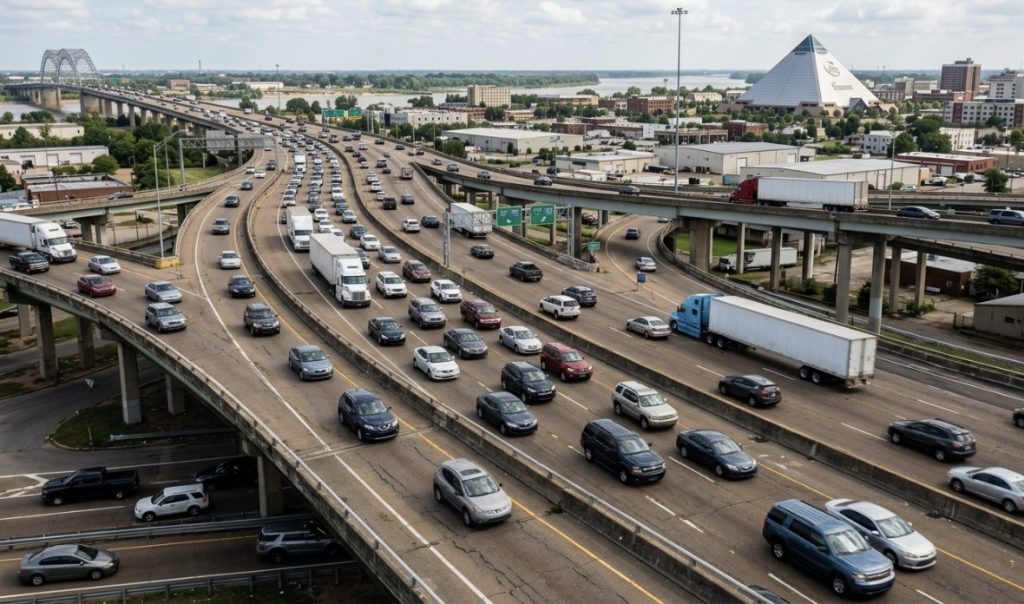
Memphis ranked as the worst city in the country for bad driver behavior in a Forbes multi-year traffic analysis. A separate 2025 study placed Memphis among the nation’s highest car crash fatality rates at 25.96 deaths per 100,000 residents. Shelby County recorded 748 serious-injury and fatal crashes in 2024, the highest of any county in Tennessee.
These numbers are not abstract for the people who drive here every day. They describe specific roads, specific intersections, and specific patterns that repeat year after year. Knowing which stretches carry the highest risk lets drivers make more informed choices about routes, speeds, and attention levels.
The Most Crash-Prone Intersections in Memphis
Data from Memphis Police Department records and WREG’s investigative reporting identified a consistent list of high-incident intersections across the city.
Poplar Avenue and Ridgeway Road hold the top spot for total collisions in Memphis. Since 2014, this intersection has averaged nearly four car crashes per week. The combination of high-speed approach lanes, commercial density, and complex turn movements makes it a consistent generator of rear-end and side-sweep collisions. Red light cameras were added here as part of a broader city enforcement initiative.
I-240 and Walnut Grove ranks first on the list of intersections Memphis Police are called to most often according to Action News 5’s 2026 crash hotspot analysis. The interchange configuration and the high volume of vehicles entering and exiting I-240 in this area make it one of the more dangerous transition points on the loop.
I-40 and Sycamore View Road recorded 227 crashes in a recent data period according to David Gordon Law’s Memphis intersection analysis. This interchange sits on the east side of the city where I-40 carries significant freight volume alongside commuter traffic.
I-240 and Lamar Avenue recorded 195 crashes in the same period. Lamar is repeatedly identified in Memphis crash data as one of the highest-incident surface streets in the city. The merge with I-240 adds interchange-level complexity to an already busy commercial corridor.
I-240 and Poplar Avenue recorded 184 crashes. Poplar Avenue appears multiple times in Memphis intersection data: once at Ridgeway and again at I-240, which reflects the corridor’s sustained crash exposure across its length.
Winchester Road at Riverdale Road ranks seventh on the list of intersections where Memphis police are called most frequently. The southeast Memphis location carries high commercial and residential traffic volumes on both approaches.
The Highways With the Highest Risk
I-240 Loop is consistently flagged by local law enforcement and Memphis residents as the most tense driving environment in the city. Short on-ramp distances, tight weave zones, and a driver culture that includes frequent speeding and aggressive lane changes make the loop unforgiving for small mistakes. The stretch between the Lamar Avenue interchange and the Walnut Grove exit concentrates the most incident reports.
I-40 Through Memphis carries the heaviest freight volume. I-40 is documented as the deadliest highway in Tennessee over a recent five-year period, with 219 fatal crashes statewide averaging about 44 deaths per year on this single route. The Memphis section handles both long-haul truck traffic crossing the bridge from Arkansas and local commuter volume, a combination that elevates severity when accidents do occur.
Lamar Avenue gets called out repeatedly in local crash reports. It runs diagonally through South Memphis and the Whitehaven area, creating complex intersection geometry at multiple cross streets. The city has identified Lamar as a priority corridor for safety improvements, including a $13.1 million federal grant to redesign the Lamar, Kimball, and Pendleton intersection.
Hacks Cross Road recorded 156 crashes in 2025 alone per Action News 5’s Shelby County road analysis. Airline Road logged 103 crashes in the same period. North Houston Levee Road recorded 88. These suburban corridors south of the city see significant growth-driven traffic increases that the road infrastructure has not fully absorbed.
What Makes These Locations Dangerous
The pattern across Memphis crash data is not random. Most serious collisions cluster around a few consistent factors.
Short merge distances on I-240 give drivers less time to match highway speeds when entering the loop. At the Walnut Grove and Sycamore View interchanges specifically, the on-ramp length requires confident acceleration that many drivers underestimate.
Distracted driving shows up in Memphis data as a leading cause at surface street intersections. The intersection at Poplar and Ridgeway sees rear-end and side-sweep patterns consistent with drivers not braking early enough on a known high-volume approach.
Freight traffic elevates accident severity. When a collision involves a loaded commercial vehicle on I-40 or I-240, the damage and injury outcomes are more severe than standard passenger vehicle crashes. Staying clear of truck blind spots on these corridors is practical advice rather than theoretical caution.
The Insurance Connection
Shelby County’s crash volume is the primary reason Memphis pays the highest car insurance rates in Tennessee. The specific intersections and corridors described above generate claims year after year, and insurers price that history into every policy written in the county.
For Memphis drivers comparing coverage options, understanding where local rates actually come from puts the premium in context. Drivers looking at car insurance Memphis options can review coverage levels for their specific ZIP code, which varies within Shelby County based on local crash and theft patterns.