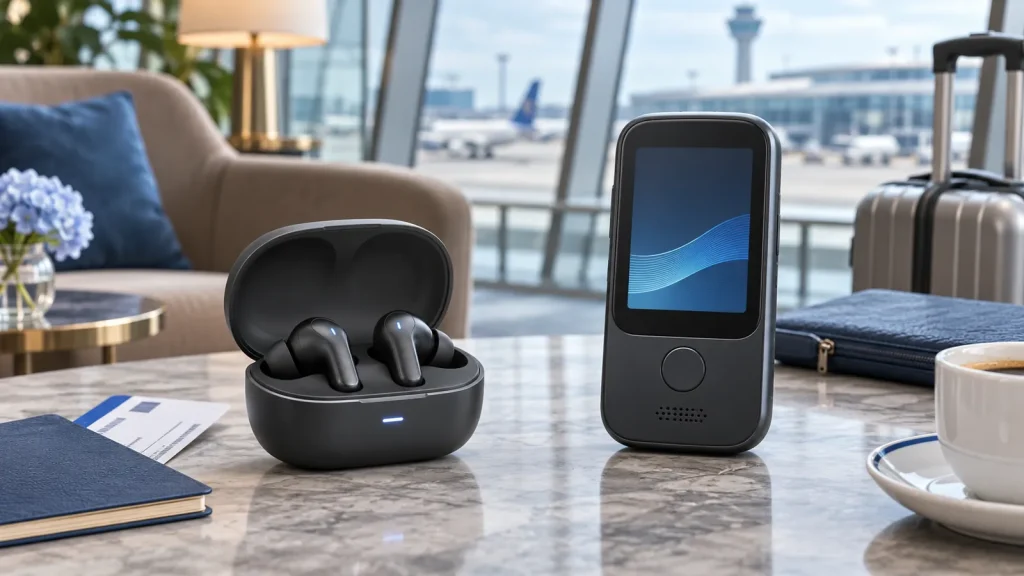
Business travel creates several kinds of language problems. A short conversation at a reception desk is different from a supplier meeting, and both are different from a conference presentation. Translation earbuds and handheld translators can support these situations, but they do not create the same experience.
Earbuds keep the user’s hands free and can make a two-person conversation feel more natural. Handheld devices are easier to share, more visible to the other person, and often better suited to quick exchanges with different people. The right choice depends on who is speaking, how long the conversation lasts, and whether the device will be shared.
When Translation Earbuds Work Well
Earbuds suit longer conversations between two people. Each person can focus on the speaker rather than repeatedly looking down at a screen. This is useful during client discussions, meals, site visits, and other situations where eye contact matters.
A pair of translation earbuds for business travel can also be less disruptive than holding a device between speakers. The conversation may continue at a more comfortable pace, especially when both participants understand how the earbuds work.
They are particularly useful when the traveler needs to take notes, handle documents, or inspect a product while speaking. Keeping both hands available matters during factory tours, demonstrations, and trade shows.
There are practical limits. Some people are uncomfortable sharing earbuds, and asking a new contact to place an unfamiliar device in their ear may not be appropriate. Earbuds also need to fit securely and remain charged throughout the day.
They work best when the same two people will talk for more than a few minutes and both are willing to use the equipment.
Where Handheld Translators Have an Advantage
A handheld translator is easier to introduce during a brief exchange. The user can place it between both speakers, explain what it does, and begin without asking the other person to wear anything.
That makes it useful for hotel check-in, transportation, ordering food, requesting directions, and speaking with different people during an exhibition. It can move from one conversation to another without changing earpieces or adjusting the fit.
The screen may also help when the translated text needs to be confirmed. Addresses, prices, dates, model numbers, and names are often easier to verify visually than through audio alone. If a translation sounds incorrect, both speakers can look at the text and correct the original sentence.
A handheld device is more visible, however. Holding it toward another person may make the conversation feel like a recorded interview. During a formal dinner or extended business discussion, the repeated motion can become distracting.
Compare the Conversation, Not Just the Device
The number of participants is one of the clearest deciding factors.
For a scheduled meeting between two people, earbuds may provide a smoother exchange. For short conversations with several employees, drivers, vendors, or event staff, a handheld translator is usually easier to share.
Group meetings are more complicated. Neither format automatically solves overlapping speech, people talking from different parts of the room, or several language pairs being used at once. A device placed near one speaker may miss someone at the far end of the table, while earbuds worn by two participants cannot cover the rest of the group.
For multilingual group sessions, establish a simple speaking order. Ask participants to use short, complete sentences and avoid interrupting one another. Translation becomes more reliable when each speaker finishes a thought before the next person begins.
Think About the Pace of the Discussion
Translation introduces a delay. In a casual exchange, a short pause is usually acceptable. During negotiations or technical meetings, frequent interruptions can make it difficult to follow the argument.
Earbuds can reduce some of the physical back-and-forth because the translated audio reaches the listener directly. Handheld translators may require each person to pause, speak toward the device, and wait for the other person to read or hear the result.
Speed should not come at the expense of clarity. Short sentences are easier to translate and confirm than long explanations containing several ideas. Instead of saying, “We can accept the revised delivery date provided the packaging passes inspection and the final samples arrive before Friday,” divide the message into separate points.
Important details should be repeated and displayed in writing. Prices, quantities, deadlines, addresses, and contract terms should not depend only on spoken translation.
Check Connectivity Before the Trip
Some translation features require an internet connection, while others may support limited offline use. This distinction matters in airports, exhibition centers, factories, and international roaming situations.
Before traveling, check which functions work offline and which language pairs require a network connection. Download any available language resources in advance. Do not assume that hotel Wi-Fi or a conference network will remain stable during an important meeting.
Battery planning is equally practical. Charge the device overnight and carry a compact power source if it will be used throughout the day. For earbuds, remember that both the earbuds and charging case may affect total availability.
Travelers comparing voice translator devices should focus on the languages, connection requirements, and conversation modes they will actually use. A long feature list has little value if the required language pair is unavailable under local network conditions.
Consider Privacy and Social Comfort
A business conversation may include product plans, customer information, pricing, or contract details. Before using any translation tool, check how speech is processed and whether audio or text is stored.
The physical setting matters too. Translated audio played through a speaker can reveal the discussion to people nearby. Earbuds provide more private listening, although the original speech is still audible in the room.
Social expectations vary. In some situations, offering an earbud feels natural. In others, the other person may prefer to speak toward a shared device. Explain the process briefly instead of placing the equipment in front of someone without warning.
For formal meetings, tell participants in advance that translation technology will be used. This gives them time to prepare shorter statements, written terminology, and translated copies of essential documents.
Bring Written Material for Critical Details
Translation devices are most useful when they support preparation rather than replace it.
Create a short glossary before the trip with company names, product terms, job titles, technical vocabulary, and common abbreviations. Keep important addresses and booking information in both languages. For a supplier meeting, prepare written versions of specifications, quantities, and deadlines.
If an important sentence produces an unclear translation, rephrase it in simpler language. Repeating the same complicated sentence more loudly rarely helps.
After the conversation, confirm decisions in writing. A short bilingual email or document gives both sides a chance to correct misunderstandings before they affect orders, schedules, or contracts.
Which Format Should You Pack?
Choose translation earbuds when:
- Most conversations will be one-to-one.
- Discussions are expected to last more than a few minutes.
- Hands-free communication and eye contact are important.
- The other participant is comfortable wearing an earbud.
Choose a handheld translator when:
- You will speak with many different people.
- Most exchanges will be brief.
- Translated text needs to be displayed and checked.
- Sharing earbuds would be inconvenient.
Some travelers may benefit from both, but carrying two devices is not automatically necessary. A consultant meeting the same overseas team for several days may get more value from earbuds. A sales representative moving through airports, hotels, taxis, and trade-show booths may find a handheld device more practical.
Also read: Smart Classrooms: How Technology is Redefining Teaching and Learning Practices
The better option is the one that matches the conversations already on the itinerary.