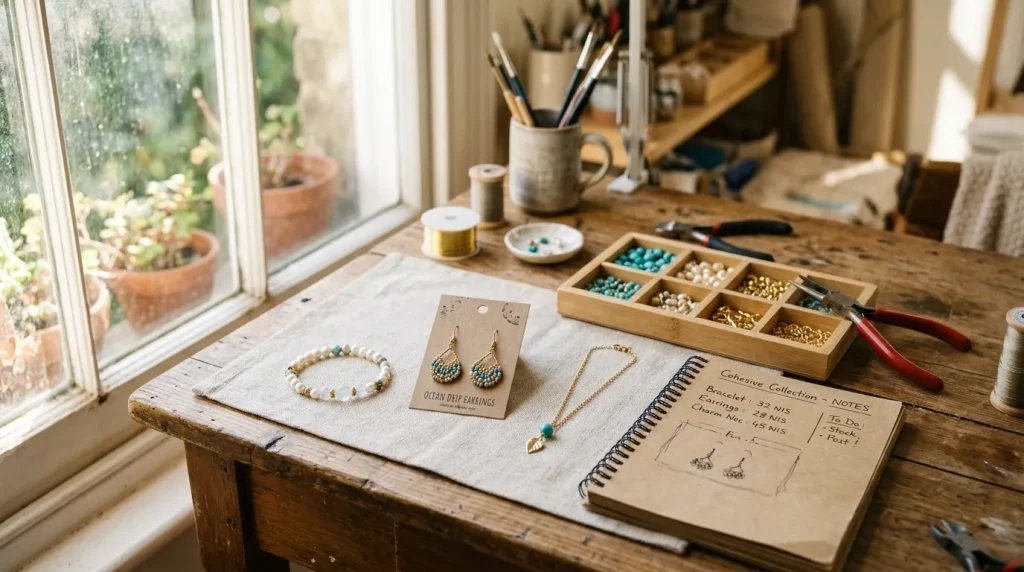
Start a handmade jewelry business with a small, cohesive collection of 5 to 8 designs that you can make consistently and sell at a price that pays for your work. Before investing in a large stock of materials, decide who the jewelry is for, make physical samples, and choose one primary channel to test your first sales. These early decisions give you a practical foundation without committing your whole budget at once.
Choose Your Customer and Jewelry Style
Picture someone buying your jewelry. Are they looking for lightweight everyday earrings, a personalized gift under $30, or a statement piece for an occasion? Choose a starting point that suits both your technical skills and the products you enjoy making.
Look at comparable handmade products in the places where you hope to sell. Read descriptions and customer reviews to see what buyers ask about—such as earring weight, bracelet sizing (e.g., standard 16–18 cm lengths), or gift packaging. Note the prices, keeping in mind that another seller’s price tells you little about their actual material costs or profit margins.
Write a short, two-sentence description of your intended collection and target customer. Use it to decide which designs belong in your first release. A clear direction prevents you from over-buying unrelated beads before your core collection is ready to sell.
Build and Test a Small Collection
Make a manageable selection of 5 to 8 finished samples. The collection should feel visually connected through a shared color palette or metal finish, while offering enough variation (such as matching studs, drop earrings, and a bracelet) to give customers a choice.
Wear the samples for a few days and check how they behave during ordinary use:
- Comfort & Fit: Do drop earrings feel too heavy after four hours? Can a buyer fasten a lobster clasp on a bracelet with one hand?
- Durability & Finish: Inspect jump ring closures and look for rough wire ends that could snag clothing. Ask someone else to try the pieces and describe any practical issues. (Note: Wearing tests check mechanical durability; they do not establish metal composition or justify regulated claims such as “hypoallergenic” without supplier material verification.)
Make the same design a second time and record how long it takes from start to finish, including inspection. If a single pair of earrings takes over 45 minutes due to a tricky wire-wrapping step, simplify the construction before listing it. Keep one approved sample as a master reference, along with exact notes on its dimensions and parts.
Source Materials for Repeatable Designs
Turn each approved sample into a complete Bill of Materials (BOM). Include every structural component alongside the decorative beads—for example, a beaded bracelet requires 0.8mm elastic or beading wire, crimp beads, wire guardians, and a clasp; drop earrings require headpins, 4mm jump rings, and ear wires.
To streamline your first order, use the reference table below to match common jewelry styles with their essential structural findings and recommended starter specifications on PandaHall:
|
Jewelry Type |
Core Beads & Stringing Material |
Essential Findings (PandaHall Categories) |
Recommended Starter Specs & Pack Size |
|
Stretch Bracelets |
6mm–8mm gemstone/glass beads + 0.8mm elastic cord |
Crimp covers (optional), small accent spacers |
Bead holes ≥ 1.0mm; buy 100-pc bead packs for 5 units |
|
Drop Earrings |
Focal beads (8mm–12mm) + seed bead accents |
Ear wires (hooks/studs), 2-inch headpins, 4mm jump rings |
0.7mm–0.8mm wire thickness; 50-pc finding packs |
|
Beaded Necklaces |
4mm–6mm beads + 0.45mm flexible beading wire |
Lobster clasps (10mm–12mm), 2mm crimp beads, wire guardians |
304 stainless steel or brass findings; 20–50 pc trial packs |
|
Charm Bracelets |
Curb/cable chain rolls + small dangle beads |
Lobster clasps, 5mm jump rings, eye pins |
Buy chain by the 5m/10m spool on PandaHall for custom sizing |
When sourcing wholesale jewelry supplies, use PandaHall’s bead and stringing-material directories to match exact hole sizes against your wire or cord diameter (such as pairing 1.0mm-hole glass beads with 0.8mm cord). Browse PandaHall’s jewelry findings categories—including stainless steel clasps, brass earring hooks, and jump rings—to filter by material finish, inner diameter, and pack quantity before ordering.
Buy wholesale beads in bulk only for the core designs you have already tested:
- Trial vs. Bulk: Keep unfamiliar components to small trial packs (e.g., 10 to 20 pieces) to verify color and quality. Once a design is approved for launch, switch to bulk packs (such as 100-piece finding packs or multi-strand bead lots on PandaHall) to lower your per-unit cost.
- Record Keeping: Save exact product codes (SKUs), hole sizes, and finish variations in a spreadsheet. Reliable SKU records ensure you can reorder identical shades and metal tones when a design sells out.
Set Your Budget and Prices
Set a clear startup spending limit—for many home-based makers, $150 to $300 is enough to cover basic pliers, sample materials, and initial packaging. Separate one-time tool purchases from consumable materials that become part of each finished item.
For each design, calculate your exact unit cost and retail price:
- Material & Packaging Cost: Add up the per-piece cost of beads, findings, stringing material, an earring card, and a protective pouch.
- Labor & Overhead: Multiply your recorded assembly time by a fair hourly rate, then add platform listing fees, payment processing fees (typically 3%–5%), and any shipping supplies you cover.
- Profit Margin: Add a healthy retail markup so the business generates profit beyond simply reimbursing your bead spend.
Compare your final price with similar pieces aimed at your target customer. If the price feels too high for your market, streamline the assembly steps or source larger wholesale pack sizes rather than cutting your own labor pay.
Prepare Your Brand and Selling Channel
Choose a business name that fits your aesthetic and check domain and social handle availability before ordering custom logo cards. A clean, consistent visual style is enough to begin—sharp product photos and accurate specs matter far more than elaborate boxes.
Pick one primary selling channel for your first release—such as an established handmade marketplace, your own standalone online store, or a local craft market—based on where your ideal buyer already shops. Review the current fee structure, payout schedule, and return policy before listing.
Photograph the actual pieces in consistent, natural daylight:
- Scale & Detail: Include a worn photo or ruler reference to show true scale, plus a close-up shot of the clasp, ear wire, and bead texture so buyers can judge the craftsmanship.
- Accurate Descriptions: List confirmed base metals (e.g., 304 stainless steel, 18K gold-plated brass), exact lengths, and basic care tips.
Before accepting orders, check the local business registration, sales tax, and jewelry labeling regulations that apply where you operate and ship. State your processing times (e.g., 2–3 business days) and delivery terms clearly.
Launch Small and Learn from Sales
Release your small collection through your chosen channel and keep stock quantities within what you can comfortably assemble and ship on time. Share behind-the-scenes photos of your workspace and explain the inspiration behind your pieces to guide interested shoppers to your listings.
Track sales alongside customer questions:
- Conversion Check: If a design gets high views but few purchases, check whether buyers are unsure about sizing, metal materials, or pricing.
- Profit Review: After fulfilling your first 10 to 20 orders, compare your actual time spent against net profit.
Use those real-world results to plan your next small batch—restocking proven bestsellers using your saved PandaHall product codes, refining unclear listings, and retiring designs that are too time-consuming to produce profitably.
Frequently Asked Questions (FAQs)
How much inventory should I buy on PandaHall for my first jewelry collection?
Start small by buying just enough materials to make 1 sample plus 3 to 5 finished units per design. On PandaHall, you can filter by smaller pack sizes to test different bead sizes, clasps, and metal finishes without overcommitting your budget. Once a design sells consistently, upgrade to larger wholesale bulk packs to increase your profit margin.
How do I make sure jewelry findings and beads fit together when ordering wholesale online?
Always check the exact millimeter measurements in the product specifications before adding items to your cart. Ensure your bead hole size is at least 0.2mm wider than your beading wire or headpin gauge, and verify that your jump rings have a small enough wire thickness (typically 0.7mm–0.8mm) to pass cleanly through clasp loops and charm bails.
What basic tools and findings do I need to start making handmade jewelry?
Visit this website: Elevating Events with Custom Floral Arrangements
Most beginner collections only require three core tools: round-nose pliers (for forming wire loops), chain-nose pliers (for opening and closing jump rings), and flush cutters. Pair these with versatile, staple findings—such as jump rings, lobster clasps, crimp beads, and ear wires—in one or two consistent metal finishes so you can mix and match parts across multiple designs.